
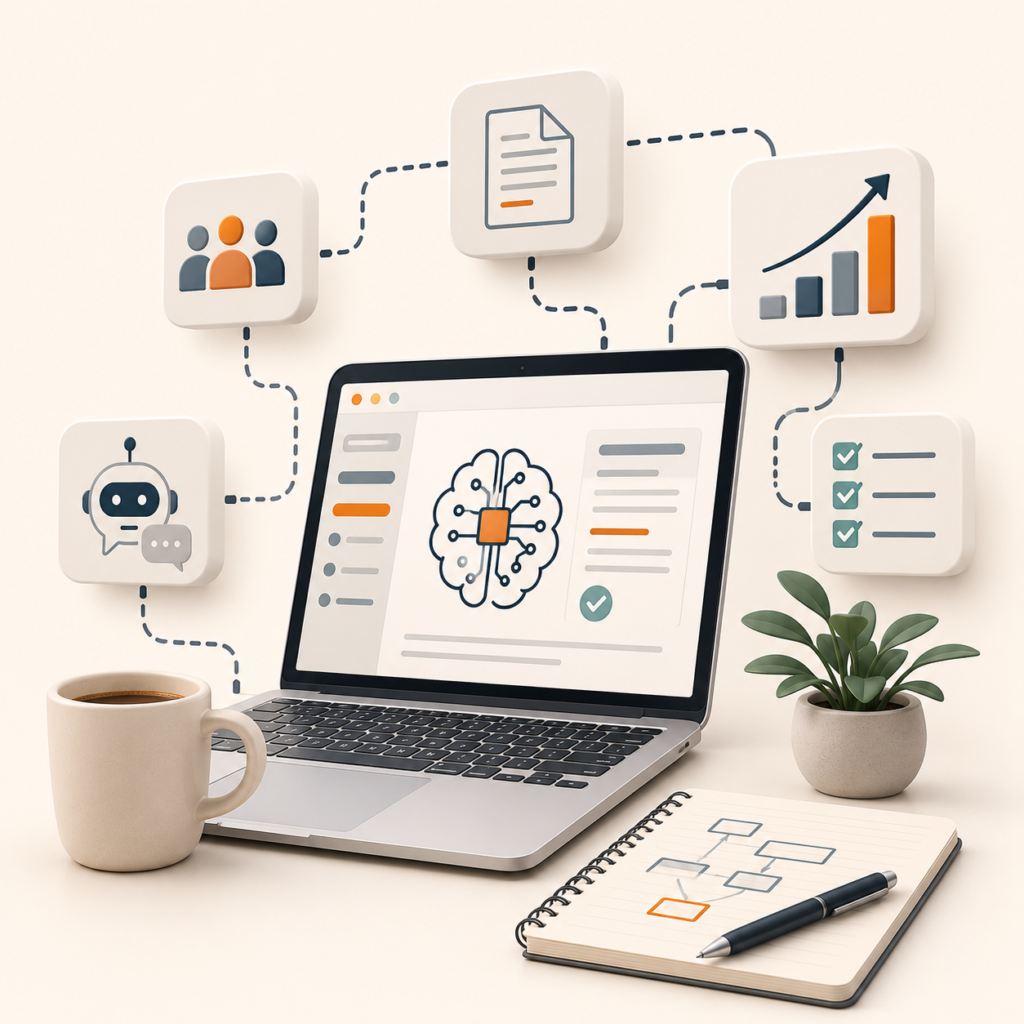
Hardly any topic creates as much pressure right now as artificial intelligence: some say without AI you’ll be gone in two years, others wave it off as pure hype. Both camps make it too easy for themselves. For small and medium businesses the truth sits in between: AI already pays off today — but only in the right places. In this guide I show which AI applications genuinely work for SMEs, how to approach the start in a structured way, and which mistakes you can spare yourself. No magic — just practice.
The real problem: where to start?
Most companies don’t fail at the technology but at the selection: the tool landscape is unmanageable, every week brings a new “game changer”, and in the end — nothing happens. Or the opposite: a tool gets adopted because everyone else is doing it, without anyone being able to say which problem it actually solves.
The way out is unspectacular: don’t start with the technology, start with your own workflows. AI is valuable when it does a concrete, recurring task faster, cheaper or better. So the question isn’t “Which AI tool do we need?” but “Which tasks regularly consume our time — and are they repetitive, text-heavy or data-driven?”
Where AI genuinely pays off for SMEs today
1. Customer enquiries: the 24/7 assistant
An AI chatbot that answers based on your own content (FAQ, product data, documentation — the RAG approach) handles standard questions around the clock, pre-qualifies leads and noticeably relieves your team. The crucial difference from old-school chatbots: modern assistants don’t make things up — they ground their answers in your sources. How that works technically is covered in my AI integration service.
2. Text and content: drafts instead of blank pages
Product descriptions, email replies, summaries of long documents — wherever text is produced daily, AI saves real time. E-commerce shows this most clearly: if you maintain hundreds of products, you can have product texts generated automatically — unique, in your own tone, SEO-ready. For shops this is often the fastest measurable AI win; more under AI for online shops.
3. Internal workflows: classify, extract, route
Sorting incoming email, extracting data from invoices and forms, routing enquiries to the right person — unglamorous tasks with huge time-sink potential. This is where the fastest payback usually hides, because the tasks are clearly defined and easily measured.
4. Multilingual content: the accelerated path to new markets
AI translation is now good enough to translate catalogues, documentation and website content as a solid foundation — with human fine-tuning for critical texts. For export-oriented businesses this lowers the threshold to going multilingual considerably.
Where you should (still) be sceptical
- “AI replaces your agency/developer”: AI accelerates professionals but replaces neither concept nor responsibility. Generated code and content without review are a risk, not progress.
- Fully automated external communication: anything that goes out unreviewed in your company’s name can damage your reputation. Humans review, AI drafts — in that order.
- AI for AI’s sake: if nobody can name the metric that should improve, the project is occupational therapy.
GDPR and data privacy: the mandatory question in the DACH region
For businesses in Austria and Germany, data privacy is not a footnote but a project prerequisite. The central questions before any AI adoption:
- Which data leaves the house? Customer data, internal documents, trade secrets — what of it goes to the AI provider, and is that defensible?
- Where is it processed? US cloud, EU data centre or self-hosted? The more sensitive the data, the more the answer matters.
- Is there a data processing agreement and a clear legal basis? Without a clean contractual footing, no production use with personal data.
The good news: for almost every use case a privacy-compliant variant exists — from EU-hosted models to local open-source solutions. You just have to plan for it from the start instead of retrofitting it later.
The structured start in four steps
| Step | Content | Result |
|---|---|---|
| 1. Task inventory | Collect and rate recurring, time-consuming tasks | shortlist of the candidates with the biggest lever |
| 2. Pilot use case | Pick a single case — small, measurable, low-risk | a clearly defined pilot project |
| 3. Build & measure | Set up the tool/integration, measure 4–8 weeks in daily use | solid numbers instead of gut feeling |
| 4. Scale or stop | Does it pay off? Expand. If not: lesson learned, move on | AI adoption that carries itself |
This path sounds unspectacular — that’s exactly why it works. It replaces the big AI strategy slide deck with a small, measurable win you can build on.
Practical examples from everyday business
The trades business has incoming enquiries categorised automatically and answered with appointment suggestions — the office staff only reviews instead of typing every email from scratch.
The online merchant generates product descriptions for 800 items automatically from product data — what would have taken months manually is done in days, consistent in tone and search-friendly.
The consulting firm gives its staff an internal knowledge base with AI search: instead of digging through folder structures, they ask in plain language — the answer arrives with source references from their own documents.
What happens if you sit the topic out?
“We’ll look at it next year” is a legitimate decision — when it is made consciously. Unconscious sitting-out, however, has a real price composed of three parts:
- The efficiency gap grows quietly: when your competitor produces quotes in half the time and answers enquiries in minutes instead of hours, you won’t see it in their advertising — only, eventually, in your numbers. AI advantages are invisible until they aren’t.
- The learning curve doesn’t shift, it stretches: the onboarding — what works for us, what doesn’t, how do we check quality — takes the same months whenever you start. Starting later doesn’t mean starting smarter, just later.
- Your team is already experimenting — uncontrolled: the realistic alternative to “orderly AI adoption” is not “no AI” but shadow IT: employees pasting customer data into free chatbots with no rules and no data protection. An orderly framework is also a protective measure.
The argument is explicitly not “everything on AI immediately” — it is: make the decision consciously, with a small pilot as your source of insight instead of gut feeling.
Toolbox: the three entry levels at a glance
| Level | What it is | Typical effort | For whom |
|---|---|---|---|
| Ready-made tools | ChatGPT/Claude in the browser, AI features in existing software | €0 setup, subscription costs | First experience, individual tasks without sensitive data |
| Integrated solutions | AI embedded in website/shop/workflow: chatbot grounded in your content, product-text automation, email classification | low four figures + API costs | SMEs with a concrete, recurring use case |
| Tailor-made | Own knowledge bases (RAG), workflows across systems, self-hosted models | project-dependent, from mid four figures | Sensitive data, high volume, special requirements |
The levels build on each other: once you have gathered experience with ready-made tools, you know far more precisely what an integrated solution must deliver — and waste no budget on requirements that turn out to be irrelevant in practice.
Conclusion: starting small beats announcing big
AI in business is no longer a question of the future in 2026 — but no reason for actionism either. The sensible path: one concrete task, one measurable pilot, data privacy considered from the start. Work this way and you build a real edge step by step while others are still holding strategy debates.
Wondering where AI could start in your company? In an AI consulting session we find the use cases with the biggest lever together — honest, neutral and without sales pressure. Request an initial call now.